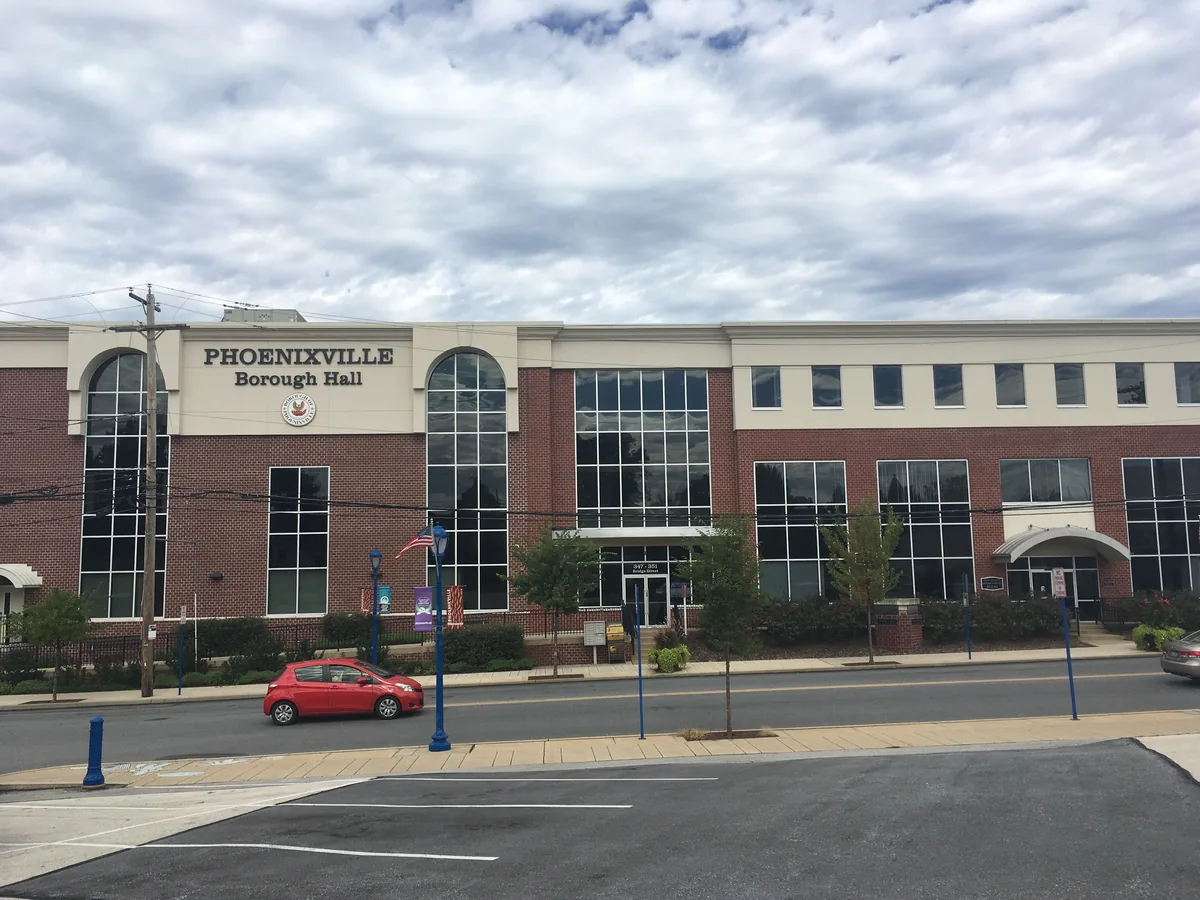

Phoenixville Borough Hall, where HARB meets. Photo: Dough4872, CC BY-SA 4.0, Wikimedia Commons, resized.
HARB Roof Replacement Rules in Phoenixville
Yes, if the house is in the Phoenixville Downtown Historic District and the roof can be seen from a street, sidewalk or other public way. HARB reviews a roof replacement there, Borough Council issues the Certificate of Appropriateness, and the borough's roofing permit comes after. Outside the district, it's the roofing permit on its own.
We are Clear Roofing & Exteriors, roofers in West Chester, PA, and our roof replacement in Phoenixville page covers how we do the job. This post covers the review that comes before it for a house in the borough's historic district. It's built from the borough's HARB page, design guidelines, application and roofing permit form, all read on November 18, 2026.
Is the house in the historic district?
Check that first, because HARB only reviews properties in the locally designated district. The borough's HARB design guidelines describe the Phoenixville Downtown Historic District as mostly commercial and mixed-use buildings from 1850 to 1930. The review rests on Historic District Ordinance No. 1736, which the borough passed in 1994 under Pennsylvania's Historic District Act 167 of 1961.
The guidelines say boundary maps are at Borough Hall and on the borough's website. If you aren't sure, call the Code Enforcement Department at 610-933-8801 before anything else. A house outside the district goes straight to the borough's roofing permit.
Which roof jobs does HARB review?
Any exterior change that can be seen from a public street, sidewalk or way. The HARB application puts "repairs and replacements" first on its list of reviewed work, and the guidelines name roofs in the building envelope HARB looks at. By that wording, a rear slope no one can see from a public way falls outside the test, so ask Code Enforcement where yours stands.
The application also defines the words you'll see on the form. "Replace in-kind" means matching the original feature exactly, including material, scale, size, finish, detailing and texture. "Replace with new" means it won't match exactly. HARB doesn't review interior work unless it changes the outside, or repainting on its own.
What do the guidelines say about roofing materials?
They favor keeping what's there and matching it when it has to go. The roofing section of the guidelines splits it this way:
| HARB encourages | HARB discourages |
|---|---|
| Regular roof inspections, maintenance and repair | Adding skylights, dishes, solar collectors, equipment, roof decks, chimney stacks or dormers that change the roof where seen from a public way |
| Replacement materials sympathetic in appearance to historic materials | New features out of character, scale, materials or detailing for the building |
| Keeping chimneys, cresting, finials, eaves and cornices | Covering, enclosing or removing eaves and cornices |
| Keeping existing roof forms and heights | |
| Replacement that matches the original color, pattern, material and texture |
The guidelines illustrate it with two mansard roofs. One kept its slate. The other has dimensional asphalt shingles made to look like slate, and in both the cornice was painted to bring out the detail. They also say regular maintenance and repair of slate can add years of life to an existing roof. Our cedar shake vs slate comparison goes through how those materials age.
Matching an older material can take some searching. One customer described it this way in a Google review that doesn't name a town:
Kept us in the loop while they searched for a shingle that matched ours (cedar shake), and then we're back as soon as they got it to fix the leak Problem solved.
What goes in the application for a roof replacement?
For repairs and replacements, the application checklist asks for three things:
- Photos: labeled digital photographs showing every public view of the building.
- Materials: samples or images of the materials to be used, such as the shingle, flashing metal and trim.
- Follow-up: anything else HARB asks for after a first consultation or review.
It all goes to the Code Enforcement Department 14 calendar days before the HARB meeting. Per the borough's HARB page, the board meets on the first Monday of each month at 5:00 p.m. at Borough Hall. The application highly recommends that the owner or a project representative attend. An incomplete application can be tabled or recommended for denial.
How long does HARB review take?
Typically three to four weeks at minimum from submission to a certificate, by the borough's own estimate, and several months if the application is incomplete or HARB asks for changes. HARB recommends approval, approval with conditions, tabling or disapproval. Its recommendation goes to the next Borough Council meeting, and if Council approves, the Borough Manager issues the Certificate of Appropriateness once all conditions are met. A denial can be appealed to the Chester County Court of Common Pleas.
Only then does the roofing permit go in. The borough's Roofing Permit Application says the Building Code Official approves or denies a residential application within 15 days, and it asks for the contractor's PA HIC number and expiration date. Ours is PA179710. Adding the borough's two stated windows together, five to six weeks or more from first filing to a permit in hand is a realistic plan for a district house.
A HARB representative reviews the finished work against the certificate. The application says completed work that doesn't match the approved certificate is subject to fines and possible removal, so any change of shingle or color after approval is a call to Code Enforcement first.
HARB and roof replacement in Phoenixville: frequently asked questions
Do you need a permit to install shingles?
In Phoenixville Borough, a roof replacement goes on the borough's Roofing Permit Application, and the Building Code Official approves or denies a residential application within 15 days. Inside the Downtown Historic District, the Certificate of Appropriateness comes first, because the borough says you need both the certificate and the permits before any work starts.
What is the best month to replace a roof?
For a house in Phoenixville's historic district, the calendar starts with HARB. The application is due at the Code Enforcement Department 14 calendar days before the meeting, meetings usually fall on the first Monday of the month, and the borough says a certificate typically takes three to four weeks. Count back from the date you want the crew.
Is restoring your roof worth it?
On a historic Phoenixville building, the borough's guidelines lean that way. HARB encourages regular roof inspection, maintenance and repair, says repairing slate can add years of life to an existing roof, and encourages keeping original materials as long as possible. When a roof is past repair, the guidelines ask for a replacement that matches the original.
What materials do you recommend, and why?
Inside the district, the guidelines answer most of it: match the original color, pattern, material and texture, and keep chimneys, cornices and eaves. Their own example shows one mansard roof kept in slate and another in dimensional asphalt shingles made to look like slate. HARB decides what's appropriate for each building, so bring samples.
For a free inspection and a written estimate on a Phoenixville roof, with photos you can use in the HARB application, call us at (484) 983-3476, 8 AM to 8 PM any day, or use the contact page. Our roofing in Phoenixville page covers the rest of the borough.
Sources, read November 18, 2026: Borough of Phoenixville Historical Architectural Review Board page, HARB Design Guidelines, HARB Certificate of Appropriateness application, Roofing Permit Application (rev. May 2023) and Permits and Applications. Review quote: Google review, shown as written. This is general information. The borough's current ordinance, guidelines and forms govern.