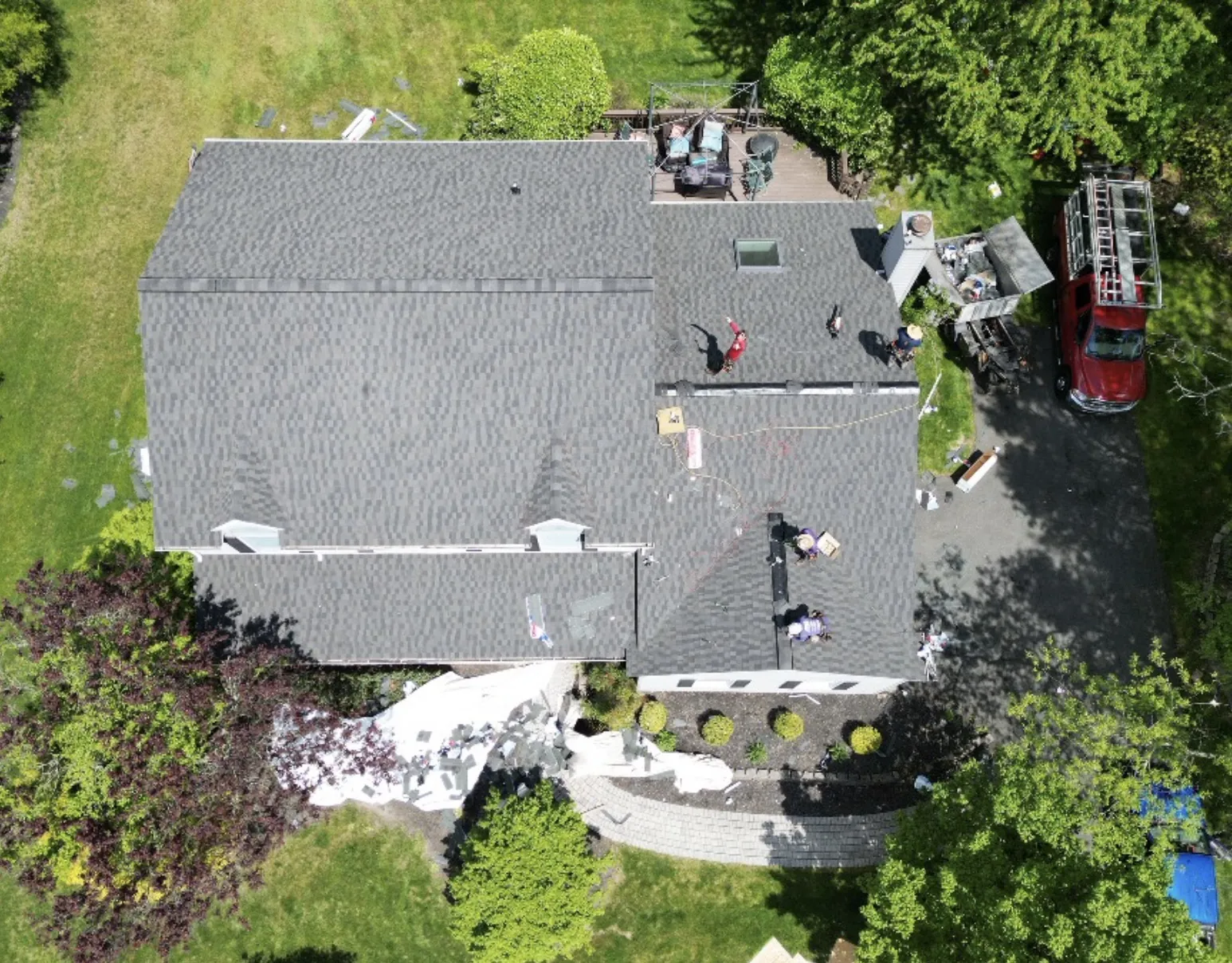
A Clear Roofing & Exteriors replacement after tear-off, with the deck covered by new underlayment. This post does not say which town it is in.
Roof decking rot in Chester County: what happens at tear-off
Decking is the layer nobody sees. It is the plywood or plank sheathing under your shingles, every nail in the roof goes into it, and when it rots, most homeowners don't find out until the old roof is off.
This post covers how decking goes bad on houses around here, what we check before we quote a replacement, and what happens on the day if the crew finds soft wood. Handling that last part openly is what separates roofers Chester County homeowners can trust from a crew that nails new shingles over the problem.
What the deck does
Work down from the top of a roof and you pass the shingles, then the underlayment and ice-and-water shield, and then the deck: plywood or plank sheathing fastened to the framing. Every nail in a new roof goes into that wood.
That is the whole reason it matters. New shingles nailed into rotten decking do not hold, and a roof built that way fails early. When we find rot, it gets cut out and re-sheathed before anything new goes on top.
How decking rots on houses here
Water does most of the damage, and it usually takes years. Leaks that never got fixed and attics that never breathed properly are the two causes we see behind rotted plywood and planks.
The leaks are often small. West Chester gets nearly 47 inches of rain a year, and it works into every worn valley and backed-out nail pop, so a slow drip can soak the sheathing long before a stain reaches a ceiling. Chimney flashing is the usual culprit.
Ventilation is the quieter cause. A roof needs balanced intake and exhaust so the attic doesn't cook it from below, and trapped heat and moisture age a roof from the inside out. That is why we check the attic on every inspection, not just the shingles.
Old layers make all of this harder to catch. On older houses around the West Chester borough we often find two or three layers of shingle stacked on the original wood decking. A layover, where new shingles go straight over old ones, can also trap heat over decking that is already going soft, and every layer added on top hides the deck from view for another round of years.
Signs you can spot without climbing up
None of these prove the deck is bad, but each one is a reason to get the roof looked at:
- A sagging roofline you can see from the street or the yard.
- Daylight showing through the attic boards.
- A stain spreading across a ceiling, or an active leak around a chimney or skylight.
- Signs of trapped moisture or poor ventilation in the attic.
- A roof that is 20 to 30 years old, or one carrying two or more layers of shingles.
Please don't go up and test the deck by walking on it. Storm-damaged decking can be soft in ways you cannot see, and a fall costs more than any roof repair. Take photos from the ground and from inside the attic instead, and show them to whoever comes out.
What we check before we quote
On a free roof inspection, a crew member walks the whole roof, checks the shingle field and every run of flashing, works the valleys, and probes the decking underfoot for soft spots. Then we go into the attic to look for ventilation and moisture problems.
That narrows things down. It doesn't settle them, because the deck is still covered. Nobody knows exactly what the sheathing looks like until the old roof is off, which is why our written estimate lists decking repair as its own line instead of hiding it inside a total.
The same limit applies to any number you get without an inspection. Our instant estimate measures your roof from satellite imagery, and it says plainly that it can't see the decking under your old shingles, how many layers are up there, the flashing or the attic. Decking is one of several things that move a replacement price, and our post on roof replacement cost drivers goes through the rest.
What happens if the crew finds rot
On a roof replacement, our crews strip everything down to bare deck. If sections are soft or rotted, they are cut out and new sheathing goes in before a single new shingle goes on.
You decide before that happens. If hidden rot changes the price, you approve the addition before we cut a single sheet of plywood. Outside of that, the figure we agree on is the figure you pay.
Replacing the wood only helps if the cause goes too. So the rest of the system goes back on in order: ice-and-water shield at the eaves and valleys, underlayment over the field, new flashing at every chimney and wall instead of reusing the old metal that caused the last leak, ventilation corrected in the attic, and the new shingle or specialty material on top.
The same goes for smaller jobs. A repair that runs into rotted decking takes longer than a straight shingle swap, because the damaged base has to come out and be replaced before the surrounding roof can be worked. You get a realistic timeline with the estimate either way.
Why we tear off instead of covering over
Code sometimes allows a new roof to go over the existing shingles. We usually recommend a full tear-off first anyway, because covering the old roof means nobody ever inspects the decking underneath. A rotted or soft deck under a brand-new roof is an expensive surprise.
A tear-off also clears every old layer at once, so the next roofer to look at the house, years from now, starts from a deck that has been seen and fixed.
If your roof is on that list
If your roof is in the 20-to-30-year range, carries more than one layer, or has started staining a ceiling, call us at (484) 983-3476, 8 AM to 8 PM any day, or book through the contact page. The inspection is free. Homeowners in the borough and the townships around it can read more on our West Chester roofing page.
Sources: our own roof replacement, roof inspection, instant estimate, Chester County, West Chester and FAQ pages, which describe how we inspect, price and replace decking. No outside figures are used in this post.